
A confluence of natural resources, industry, and economic rebirth deep in the Olympic Peninsula
By Jacquie Goodwill, OEDC MarCom manager
Forks Prairie spans 3,000 acres at the northwest tip of Washington. It is located at the fork, or confluence, of the Bogachiel, Callawah and the Soleduck rivers. The Hoh and Quillayute tribes made their livelihood by fishing, hunting and harvesting what they cultivated from the land. In the late 1800s, white settlers were drawn to forks by the huge Douglas fir forests and ample water and food resources.
The rise and fall of the timber industry, generating outstanding wealth, then loss
Despite that early westward expansion, the City of Forks was only incorporated in 1945. From the 1950s to the early 1980s, timber was king. Forks was again situated at the confluence – this time as a logging epicenter.
By 1980, the City of Forks boasted it had the highest number of millionaires per capita in Washington.
And then the bottom dropped out of the lumber market. Today, Forks has among the highest poverty rates of Washington cities, with recent figures showing that about 25% of the population lives in poverty.
The city and a consortium of partners across industry, education and community aims to change that.
Reigniting the Forks economy
In 2025, Riverside Forest Products USA, the U.S. subsidiary of Canada’s Riverside Forest Products Inc., announced it would develop a sawmilling facility in Forks. This follows a strategic collaboration among business, government, community and conservation groups. The $12 million combined public and private investment includes $400,000 from the Washington State Department of Commerce.
“This could be the spark to re-ignite the Forks economy,” said Colleen McAleer, executive director of the Clallam County Economic Development Council (EDC). “It represents the culmination of our multi-faceted approach to ensuring Forks offers a compelling opportunity, like we’re seeing with Riverside Forest Products.”
When it opens, anticipated in 2026, this new facility is expected to create approximately 25 to 40 new family-wage jobs in the first phase of operations. A second phase will add about 30 more jobs, with an anticipated total of 70 to 100 jobs, depending on market demand for the products produced at this mill.
A team effort for economic opportunity
”We all share the goal of bringing family-wage jobs and economic vitality to Forks,” Colleen said. The City of Forks, Clallam EDC, the Port of Port Angeles, Clallam County and higher education organizations joined forces in this important work.
“At the Clallam EDC we chose to focus on one industry, forest products, to make the greatest positive impact in one area. This industry offers the highest wages in the county, it just needs innovation, technology infusion and a focus on sustainability to grow,” Colleen explained.
Together, they made strategic infrastructure and workforce development investments. Commerce supported their work in specific areas, including two Evergreen Manufacturing Growth Grants and a Strategic Reserve Fund grant totaling about $400,000.
Getting plugged in
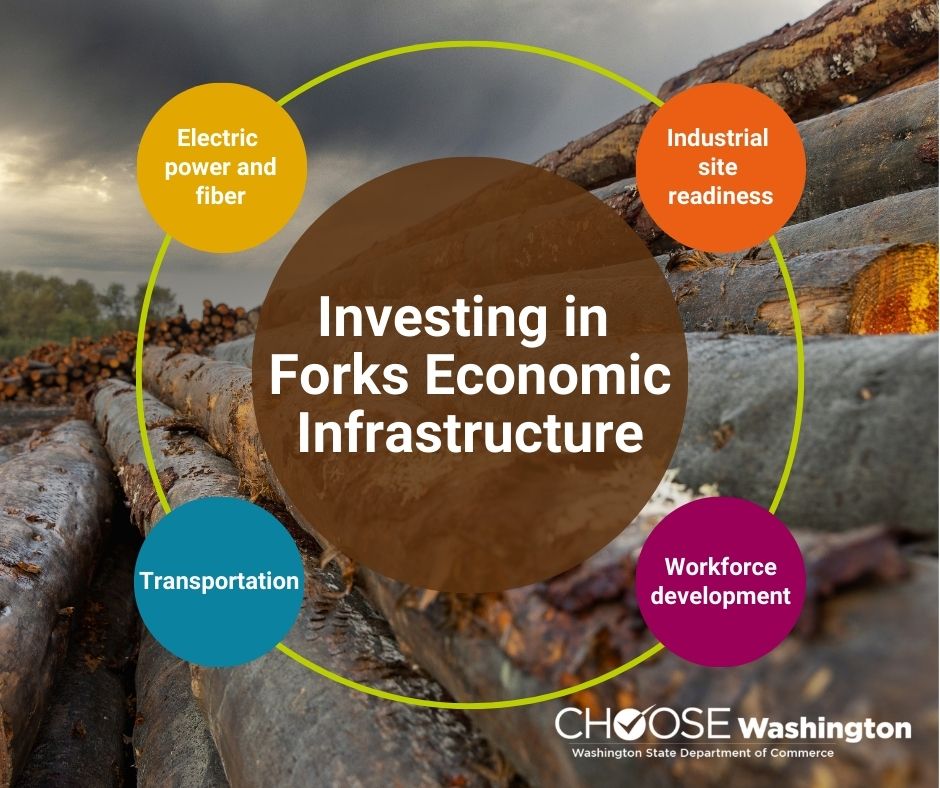
Lumber and wood products processing requires abundant electricity, as well as a robust fiber optic connection to speak with suppliers, customers and more. The Forks electricity supply has been particularly challenging.
A Governor’s Strategic Reserve Fund Grant of $200,000, administered by Commerce and the Clallam County EDC, aimed to alleviate that. The grant covers equipment costs and electrical tenant improvements for the site. It will also support the second phase to upgrade power capacity at the city-owned Industrial Park. In November 2025, The Board of Clallam County Commissioners added their support by approving a $935,000 request, a combination of loan and grant funding, from the City of Forks to provide additional power capacity at the site.
Higher ed partnerships cultivate workforce development
The collapse of the timber industry resulted in hundred of layoffs and a significant loss of professional and institutional knowledge, the kind needed to manage the new mill. That’s when a unique consortium, including business, government, educational organizations, conservation groups and community partners stepped in.
The community received a unique $4.2 million federal Economic Development Agency (EDA) economic development grant, then the consortium raised an additional $1 million in matching funds in less than three weeks. The Olympic Natural Resources Center, managed by the University of Washington, Oregon State University and Peninsula College partnered to create a program called “Investing in Forestry Skills: A Technology-Focused Workforce Training Program.”
That means the workforce will be ready.
“Along with power, offering a well-trained workforce to a prospective mill operator is essential,” Colleen said.
The center has tremendous capabilities in Lidar, both ground-based and drone based on radar technology, which maps the forest to understand a specific plot of land. This big data is then relayed to OSU to plug into forest equipment, so a harvester can bring the right equipment at the right time, minimizing forest floor impact and carbon emissions. Peninsula College trains their students on equipment operation.
Phase II operations – industrial symbiosis at work
Once the tree is harvested, then comes the decision of how to use it. Typically, when harvested for lumber, only 40% of a tree is used. Sawdust, bark, stumps and limbs are considered “residuals” and form biomass. These wood biomass residuals exist on a sliding scale, from the high-value wood shavings of kiln-dried lumber to what’s referred to as “hog fuel,” for wood boilers.
An Evergreen Manufacturing Growth Grant award of $200,000 had two components to make use of the different tree products. First, the team commissioned a wood fiber and residuals study to identify the amount of available wood and residuals within the North Olympic Peninsula.
Transportation is about knowing what you will transport … and how
A 2025 report on north Olympic Peninsula wood fiber detailed the advantages of water transportation for pulp and paper mills over trucks and railways. So, the Port of Port Angeles will invest in three barges to transport wood residuals with the proceeds of the Federal Recompete award.
“Now, we can access nearly 3.8 million tons annually of biomass that doesn’t have a market and is burned or emitting carbon into the atmosphere,” Colleen said. “More products equal more jobs.”
The second component of the Manufacturing Growth Grant created a new product line at the Composite Recycling Technology Center. The team designed an advanced cross-laminated timber panel structure using thermally modified hemlock that adapts for use as a four-unit housing complex or a single-family dwelling.
Bringing it all together to build a sustainable community
“All of these investments focus on how to innovate the forest products industry right here in Forks,” Colleen said. “Collectively, our goal is to create value-added products locally, so that we’re not just harvesting and sending out lumber for processing.”
The community is focused on educating and employing their workforce, producing sustainable forest products that fuel the housing and building products industries. This powerful consortium aims to create more sustainable systems to further use of tree harvests. It could truly be the spark that reignites the Forks economy for years to come.